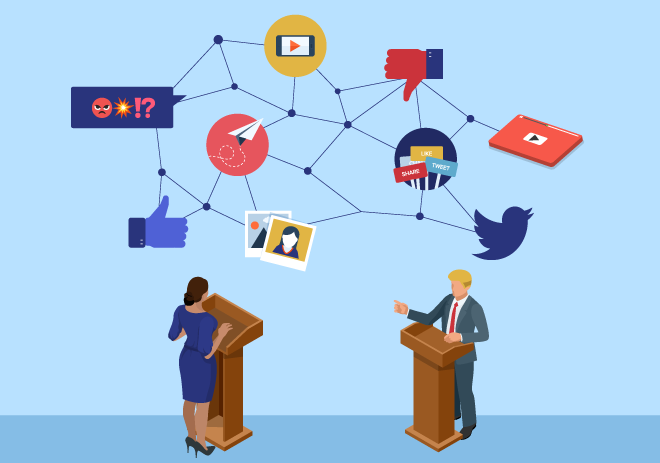
Danish politicians are often harassed on social media such as Facebook and Twitter. In many cases, these are serious personal attacks and sometimes also threats of violence, rape or murder. The abuse can have serious consequences for both the politicians involved and for our democracy, as it can undermine public debate and lower the desire among Danes to participate actively in politics. The abuse can also increase inequality in politics, for example, because female politicians are more negatively affected by abuse than their male colleagues.
How to stop incitement against politicians?
In two sub-projects, we investigate what forms of abuse politicians are exposed to and which interventions might help dampen the abuse.
In sub-project 1, we develop a tool to better measure the abusive messages directed at politicians on social media. We then use the measurement tool to examine the patterns of harassment. This sub-project thus provides a better overview of the exact forms of online abuse that Danish politicians are exposed to and what the politicians themselves perceive as abusive citizen behavior. The project also allows tracking the pattern and frequency of abuse over time.
In sub-project 2, we examine the effect of interventions aiming to reduce online abuse of politicians. We test the effect of online interventions that motivate citizens and politicians to participate actively in the fight against online abuse. Specifically, we investigate whether norms enforced by politicians and other citizens can change attitudes and behavior when it comes to reducing harassment on social media. One of our central hypotheses is that condemnation of abusive comments to a politician is most effective if the condemnation comes from a political opponent. This sub-project thus informs future efforts to combat online abuse.
Methods and data collection
Sub-project 1 is based on qualitative interviews, a survey among Danish politicians, and text analysis of posts on social media. The qualitative interviews and survey are used to reveal Danish politicians' own experiences with harassment, not least exactly what factors makes a message abusive in the eyes of politicians.
Based on the results, we then collect and classify posts directed at Danish politicians on social media. This analysis is based on a machine learning approach, where a small number of manually analyzed messages are used to develop an algorithm that can subsequently classify a large number of social media content.
Sub-project 2 is based on surveys among a representative sample of Danish citizens. These surveys will help reveal how citizens perceive (potentially) abuse messages to politicians. This allows us to compare and discuss perceptions of abuse among politicians and the public, respectively. The surveys also contain a number of randomized experiments that allows us to test the effect of interventions aimed at limiting the harassment of politicians online.
